Training defenders, writing blueprints, building cutting-edge AI tools, and tracking global outbreaks in real time — one platform for genomics surveillance, outbreak intelligence, and pandemic preemption.
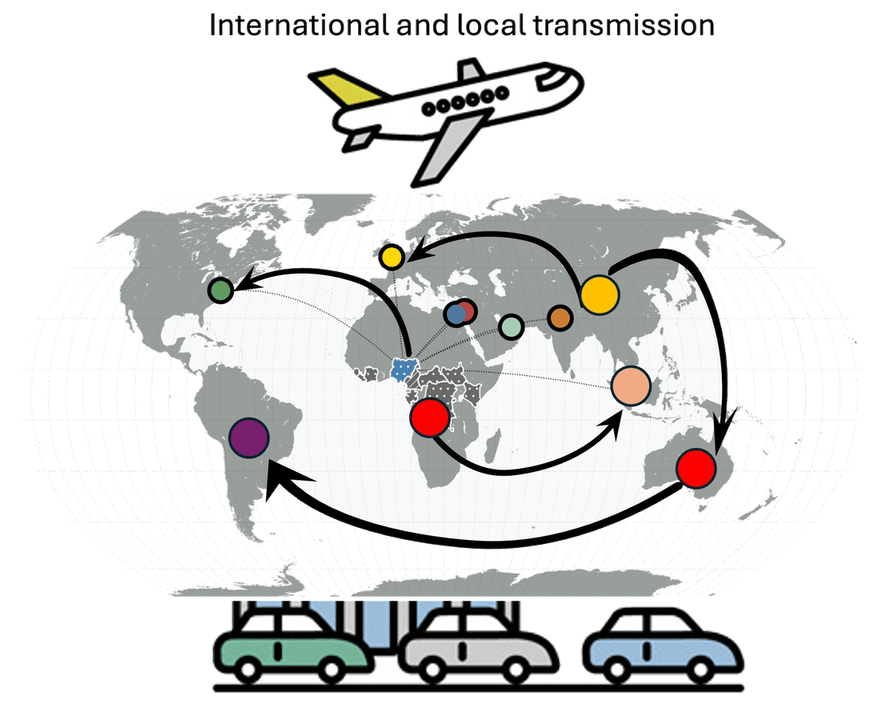
Africa faces a Capacity Paradox — sequencing hardware donated after COVID-19 sits idle because the trained workforce, national strategy, and sovereign data infrastructure to use it do not exist. RadarGenomics is building all four pillars, in parallel.
Training a horizontal Bio-Intelligence workforce capable of analysing metagenomic, wastewater, and vector-borne data across pathogen families. Already active across 16+ African countries.
Designing National Genomic Blueprints for Ministries of Health — integrating multi-sentinel surveillance, data sovereignty frameworks, and biosafety protocols tailored to African contexts.
Deploying AI-powered surveillance nodes — wastewater, aircraft waste, hospital, and vector monitoring — so Africa detects pathogens in the environment before they reach hospitals or cross borders.
Developing cutting-edge technologies — from Graph Neural Network epidemic forecasters and VirCapSeq-VERT metagenomic pipelines to sovereign AI platforms — engineered specifically to prevent the next pandemic and epidemic before it starts.
Our framework spans emerging and re-emerging pathogens — viruses and bacteria alike — integrating genomics, AI, and ecological data to provide actionable early warnings at national and regional scale.
Community-level detection of viruses and bacteria through environmental metagenomics, enabling population-scale early warning before clinical cases emerge.
Screening international flight wastewater to intercept cross-border pathogen introductions at ports of entry before they seed community transmission.
Syndromic and genomic sentinel surveillance in clinical settings to detect unusual clusters and emerging variants — viral and bacterial — before outbreak thresholds are breached.
Metagenomic surveillance at zoonotic spillover hotspots — livestock, wildlife markets, and forest frontiers — to intercept novel pathogens before first human transmission.
Population genomics and pathogen screening of Aedes, Anopheles, and other vectors to map transmission risk and detect emerging arboviruses before epidemic spread.
Graph Neural Networks and transformer models integrating genomic, ecological, and mobility data to deliver actionable multi-horizon epidemic forecasts for health authorities.
We meet institutions where they are and scale alongside them through every phase of preparedness.
Workforce-as-a-Service. Expert teams embedded for 12–24 months, delivering hands-on training across Pathogen, Human, AMR, and Environmental genomics. Currently active with IHVN and Africa CDC across East and West Africa.
National Genomic Blueprints for Ministries of Health — integrating multi-sentinel surveillance (wastewater, vectors, hospital), data sovereignty frameworks, and biosafety protocols. Our model enabled IHVN to secure a $10,000 grant for Nigeria's first Disease X wastewater pilot.
Radar Cloud — a sovereign data lake for African genomic data — plus AI-driven surveillance nodes spanning wastewater, aircraft waste, hospital sentinel, human–animal interface, and vector monitoring, completing the transition to proactive biosecurity.
Signed contracts, professionals trained across the continent, and international funding secured for partner institutions — before a single external investment round.
A retainer engagement delivering genomics training and infrastructure guidance for the NIH-funded INFORM Africa Project, working with population-scale HIV and SARS-CoV-2 datasets across Nigeria and South Africa.
Designed the full surveillance architecture — AI-driven pathogen detection, VirCapSeq-VERT metagenomic workflows, and REVEAL geospatial canal mapping — enabling IHVN's first Disease X wastewater pilot in Nigeria's Federal Capital Territory.
Advanced genomic epidemiology modules delivered for public health professionals from eight East African countries as part of the African Pathogen Genomics Initiative.
Trained professionals from 12 African countries in sequencing QC, bioinformatics pipeline interpretation, and genomic data visualisation for public health decision-making.
Analysis, commentary, and deep dives from the RadarGenomics team on genomics surveillance, pandemic preparedness, and Africa's biosecurity future.
Ifeanyi is a computational infectious-disease epidemiologist completing a PhD in Molecular Evolution, Epidemiology, and Phylogenetics at the University of Edinburgh, supervised by Prof. Andrew Rambaut FRS. His doctoral work elucidated the zoonotic origins, evolution, and transmission dynamics of Ebola and Mpox, with findings published in Science and Nature.